
LoRaMod
Advanced Wireless Modbus Router
Wireless Modbus Communication For Industrial Environments
Long-Range Modbus, Engineered Into the Device
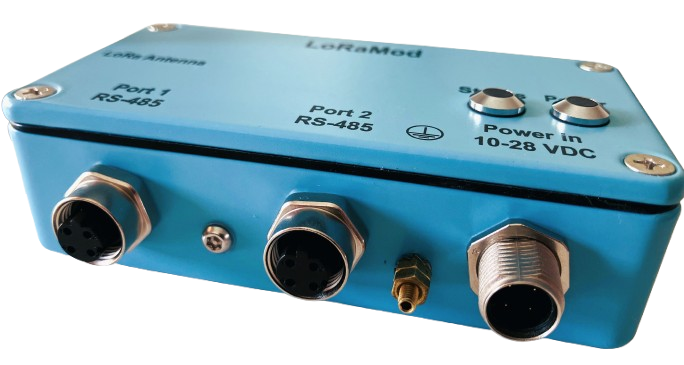
Available in Two Models for Different Integration Needs
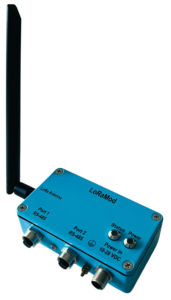

Designed for Real Industrial Deployments







LoRaMod’s Main Features
LoRaMod not only extends Modbus packets wirelessly; it functions as an industrial router that introduces structural control over the network.

Device Mappings: LoRaMod decouples the Modbus map from the controller from the actual addressing of remote devices.
Using a configurable Device Mappings table, LoRaMod allows the address space of the controller (PLC, data logger, or SCADA) to be decoupled from the actual space of devices in the field. The control system can operate with the most convenient logical ID map, while the downstream connected devices maintain their original physical addresses.
LoRaMod automatically manages traffic translation and routing, completely transparently to the controller. This avoids ID conflicts, simplifies progressive expansions, and allows legacy equipment to be integrated without reconfiguration, resulting in a more orderly, scalable, and maintainable network in the long term, even in installations where the architecture has evolved over many years.
LoRaMod incorporates an optional Modbus cache system designed to optimize wireless communication performance when required by the application. This functionality, manually activated by the user, improves both radio link efficiency and stability in the presence of controller timing limitations.
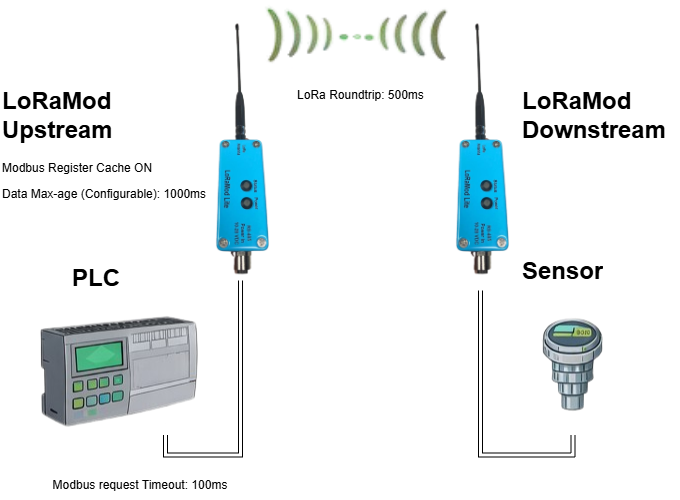
Modbus Cache compensates for wireless link latency by storing and delivering responses within the controller timeout.
When the Modbus register cache function is enabled, Upstream automatically groups requests addressed to the same device on consecutive registers—even with jumps of up to 16 addresses—consolidating them into a single, more efficient transaction. This reduces airtime and optimizes the use of the LoRa channel.
Additionally, responses received from the Downstream are stored in a cache with a configurable validity time. As long as there is no data update, the system can respond to new requests directly from that local memory. This is especially useful when the PLC or datalogger timeout is less than the actual round-trip time of wireless communication, avoiding errors in systems originally designed for wired links.
LoRaMod incorporates a security model based on Perfect Forward Secrecy (PFS) applied to each data packet transmitted.

Industrial-grade security with Perfect Forward Secrecy (PFS) per data packet
Each message has a unique, ephemeral encryption key, preventing the reuse of static keys over time. Even if an attacker were able to capture traffic over long periods, the potential future exposure of a persistent key would not allow adjacent communications to be decrypted. Each packet is protected by unique keys that cannot be reconstructed retrospectively.
By limiting the temporal impact of any security compromise and avoiding cumulative cryptographic dependencies, LoRaMod introduces an industrial-grade layer designed for systems that must operate securely over the long term.
Polite Spectrum Access (PSA): regulatory compliance and high frequency
LoRaMod implements a PSA mechanism to operate in sub-GHz ISM bands, aligned with applicable regulatory requirements and frameworks that include mechanisms such as Listen Before Talk and channel occupancy control. Before transmitting, the device evaluates the status of the radio channel and manages access in a controlled way, reducing interference with other systems sharing the same radio environment, which significantly increases the probability of packet delivery.
This mechanism also allows operation with transmission intervals typical of industrial environments, on the order of milliseconds, well below the typical times of conventional LoRa transmitters that operate on scales of seconds or minutes.
A basic LoRaMod network consists of at least two devices, each configured with a specific function to ensure efficient data transmission over long distances without the need for complex infrastructure. The network operates using a star topology, in which one device acts as the central node (Upstream) and the others act as peripheral nodes (Downstream). LoRaMod devices can be programmed to take on either of these two roles in the network.

The network operates using a star topology, in which one device acts as the central node (Upstream) and the others act as peripheral nodes (Downstream)
Upstream
A LoRaMod device configured to operate as the network’s central node, managing wireless links with up to 4 downstream devices and connecting directly to data loggers, PLCs, or SCADA systems via RS-485, linking wired and wireless networks without the need for additional gateways.
Downstream
A LoRaMod device configured to operate as a remote field or edge node, connecting Modbus sensors or actuators to the upstream via a secure point-to-point LoRa connection, extending control and monitoring to areas where wired connections would be impractical or costly.
LoRaMod Device Manager is the software used to set up and commission LoRaMod systems. Connecting via Bluetooth Low Energy (BLE), it allows users to configure each device as an Upstream or Downstream unit, pair devices within the network, and test LoRa communication on-site. The tool also enables the setup of the end-device map within the network, provides options to fine-tune communication parameters for each project, and includes the ability to activate the Modbus cache for faster and more efficient data handling.
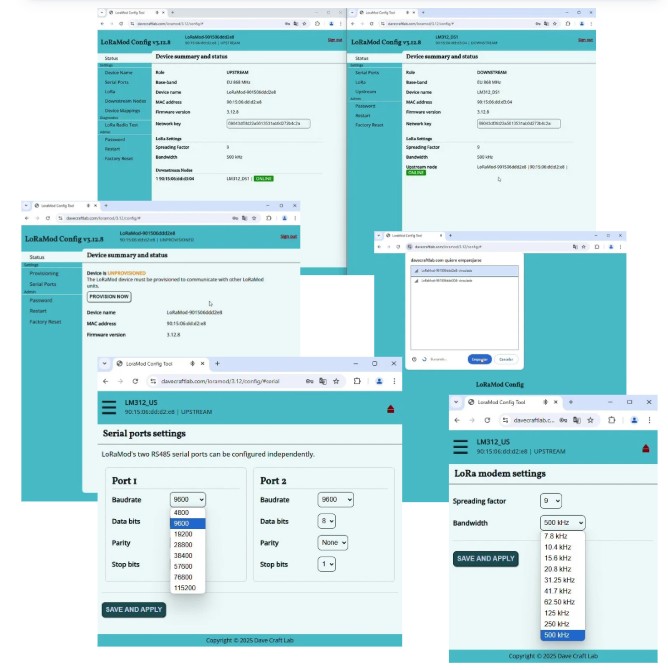
Once powered, LoRaMod activates its BLE connection, through which it is possible to communicate with the device for configuration. Using a computer, tablet or mobile phone, with enebled Bluetooth connection, open the following web address in your browser: https://www.davecraftlab.com/loramod/4.8/config
Note: the browser must support Bluetooth web connection. We recommend the use of Chrome/Chromium 56 or higher, however, in the following link you can check the one that best suits your needs: https://caniuse.com/web-bluetooth